Half a Tank of Gas, One Night Out: The Case for the Close-to-Home Bivy
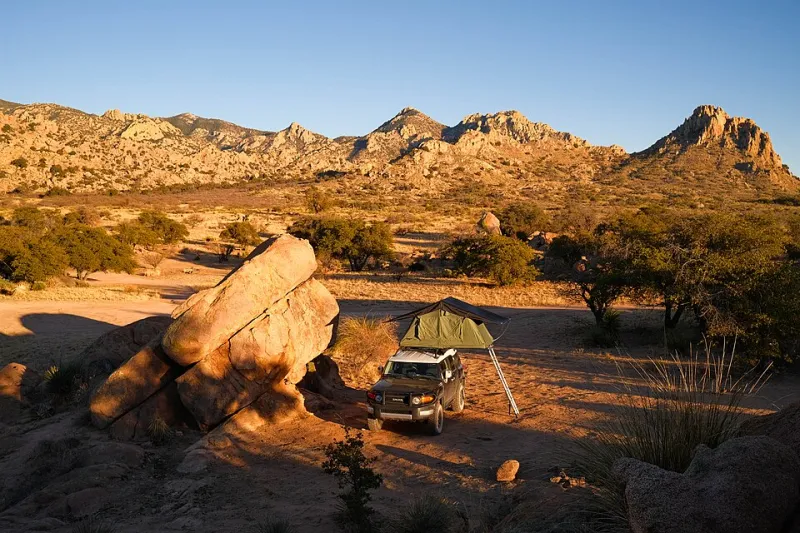
Photo: Dane from Oxford, Mi, CC BY 2.0, via Wikimedia Commons
There is a category of trip that never earns a name on a map. You leave work on Friday, drive ninety minutes, walk twenty, sleep on the ground, make coffee at first light, and are back at your own kitchen table before lunch. No summit. No permit lottery. No training plan. It sounds like a compromise, and it usually turns out to be the most restorative night of the season.
Somewhere along the way most of us absorbed the idea that wildness scales with effort, that a night out only counts if it cost a flight, a vacation day, or months of anticipation. So we wait for the big window, and the big window opens once or twice a year. Meanwhile there is a national forest well inside your gas tank's range with a gravel road running through it and nobody camped on it.
Why Smaller Trips Give You More
Frequency beats magnitude. Someone who sleeps outside a dozen nights a year in ordinary places learns more about weather, light, and their own gear than someone who does one spectacular week in July. You get faster at packing. Better at reading a forecast. Less dramatic about rain. The outdoors stops being an event and starts being a habit.
There is also the solitude math nobody talks about. Trailheads are crowded because they have parking lots, signage, and a listing in every app. A half mile up a forest road that appears on no one's bucket list, you can have an entire drainage to yourself. Not because it is secret. Because it is unremarkable, and unremarkable is a superpower.
Step One: Shop for Public Ground, Not Scenery
Start with ownership, not views. Pull up the Forest Service or BLM page for the ranger district closest to you and download the motor vehicle use map. That PDF is unglamorous and enormously useful: it shows which roads are legal for vehicles, which gates close seasonally, and where dispersed camping is allowed along them. Overlay public-land boundaries on a topo app like CalTopo or Gaia, and keep a paper Benchmark or DeLorme atlas in the passenger seat as the backup that never needs a charge.
Look for a contiguous block of public land roughly 45 to 120 minutes from home, reachable by a road a sedan can survive, with a spot to park that does not block a gate. Then find what sits a short walk beyond the car. You want somewhere between five and forty minutes from the bumper: far enough that road noise fades out, close enough that you are not making complicated decisions in the dark.
Step Two: Make One Phone Call
Best four minutes you will spend all week: call the district ranger station. Ask three questions. Is the road open? Are there fire restrictions? Is dispersed camping allowed where I am looking? Rangers know about washouts, logging traffic, and the gate that shuts a week earlier than the website says. A phone call beats a Friday night spent driving in circles.
Step Three: Pack the Boring Kit
You are not assembling an expedition. You are assembling a bag you can grab without thinking hard:
- Shelter you have actually pitched before, whether tarp, bivy, or a small tent.
- A sleep system rated a step colder than the forecast, and a pad with an R-value matched to the ground temperature rather than the air.
- Two to three liters of water and a filter. In cold weather, sleep with the filter so it does not freeze.
- One hot dinner, one breakfast, and a stove small enough to be worth carrying.
- Headlamp plus spare batteries. In November, dark arrives around 5 p.m. and stays a while.
- A small repair pouch, a paper map, and a lighter.
Leave No Trace is not a poster in a visitor center, it is the operating manual. Camp on rock, gravel, or duff instead of untouched grass. Dig catholes six to eight inches deep and 200 feet from water, or pack waste out where soil is thin. Check the fire ring twice, and on most late-fall nights the right call is no fire at all.
Step Four: An Itinerary With Nothing in It
- Friday, 4:30 p.m. Leave. Bring car snacks and the thermos you will be glad you filled.
- 6:15 p.m. Park. Boots on, headlamp around your neck, not switched on yet.
- 6:45 p.m. Walk until the road noise quits. Set up, cook, eat.
- 8:30 p.m. Here is the part people forget to protect: do not fill it. Sit in the dark. Listen for something.
- Saturday, 6:45 a.m. Coffee. Cold hands. The actual reason you came.
- 9:30 a.m. Break camp, pack out everything, including the tea bag.
- 11:00 a.m. Home with a shower and a whole weekend still in front of you.
Cold-Season Fine Print
The crux in winter is rarely the camping. It is the road. Snow can turn a graded forest road into a skating rink a mile before your spot, so check conditions and carry traction or chains if the forecast hints at anything. Tell someone where you are going and when you will be back, even if it is a text to a friend who will not read it until Monday. Bring more light than you think you need, because a 4:45 p.m. sunset means most of your trip happens after dark, and that is the entire point.
What You Are Actually Buying
The wild does not come with a minimum mileage requirement. It comes with a gate, a road, and a decision to go. Lowering the barrier is not cheating, it is how people end up outside forty nights a year instead of four. Pick a Thursday, find a green square on a map, and give yourself one night. The drive home takes less time than the meeting you would have sat through instead.