Before You Step Off: Reading the Wild Edge at the Trailhead
Most trailheads ask you to do two things: park and hurry. The lot is a staging ground, the register is a formality, and the first mile is something to get through on the way to the good stuff. I have done this hundreds of times. Boots on, pack cinched, head down, moving. The wildness, I tell myself, starts beyond the gate.
But the edge is where the wild actually meets the road. It is a seam habitat: gravel shoulders, mowed verges, culvert mouths, fence lines, ditch water, and the first tangle of weeds that the mower missed. That edge is not a lesser wilderness. It is the most accessible wildness on the whole trip, and most of us walk right past it.
The Edge Is Not the Waiting Room
Think about what a trailhead actually is. It is a disturbance. A road cut, a parking area, a drainage ditch, a signpost. Disturbance creates edges, and edges create variety. Sunlight reaches the ground in ways it does not under a closed canopy. Water collects where it would otherwise run off. Seeds arrive on tires and boot treads. Insects, birds, small mammals, and predators all work that narrow band between the human world and the forest, desert, or ridge beyond.
That is why the trailhead can feel surprisingly alive. A culvert is a cave for frogs. A fence line is a highway for deer mice and a perch for raptors. A weed patch in gravel is a pollinator buffet. Scat on the shoulder tells you who was here before you, and what they ate. None of this requires a long hike, a permit, or a summit. It requires only that you do not treat the first hundred yards as a hallway.
A Fifteen-Minute Practice
This is not a birding competition or a species-counting exercise. It is a way to arrive before you start walking. Give it fifteen minutes at the trailhead, before you tighten your laces. The only rule is no headphones and no rush.
Minutes 0 to 3: Stand still
Park, step out, and leave your pack in the car or set it down. Do not adjust anything. Stand at the edge of the lot and let your eyes soften. You are not looking for a view. You are letting the place register. Notice the direction of the wind, the temperature difference between sun and shade, the sound of the road behind you and whatever is in front.
Minutes 3 to 7: Look down and close
Drop your gaze to the first ten feet around you. Look at the gravel, the curb, the base of the sign, the drainage channel. What is growing where it was not planted? Where has water carved a small channel? Are there tracks in the dust, seeds on a stem, ants on a crushed cracker? This is the scale most of us skip. It is also the scale where the edge is most obvious.
Minutes 7 to 11: Listen
Close your eyes if you are comfortable doing so. Separate the sounds. Traffic is one layer. Wind is another. Then listen for the smaller layers: insects, a bird scolding, leaves ticking, water moving in a ditch. You do not need to identify anything. You are just recalibrating from human speed to wild speed.
Minutes 11 to 15: Read the seam
Find the line where the maintained world stops and the unmaintained world begins. It might be the edge of the mowed strip, the last fence post, the end of the pavement, or the first patch of native grass. Follow that seam with your eyes for twenty or thirty feet. What changes? What crosses it? Where does the wild slip through?
Then put your pack on and walk. You will be surprised how much more you notice for the rest of the day.
Desert Ditch, Appalachian Pullout
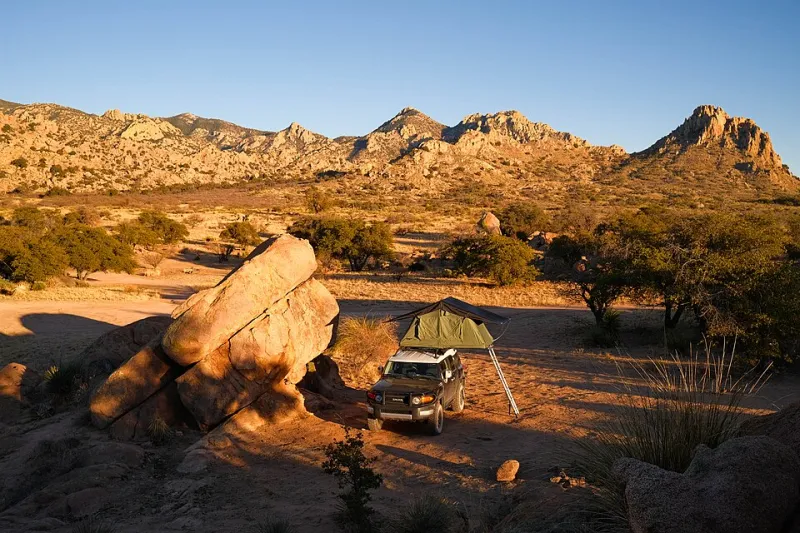
The practice travels well. At a desert trailhead in the Coronado National Forest, the edge might be a dusty pullout below a sky island. The wildness is in the shade of a palo verde, the tracks of a javelina in the wash, the cicadas winding up in the heat. You do not need to hike into the mountains to meet the place. You meet it at the culvert.
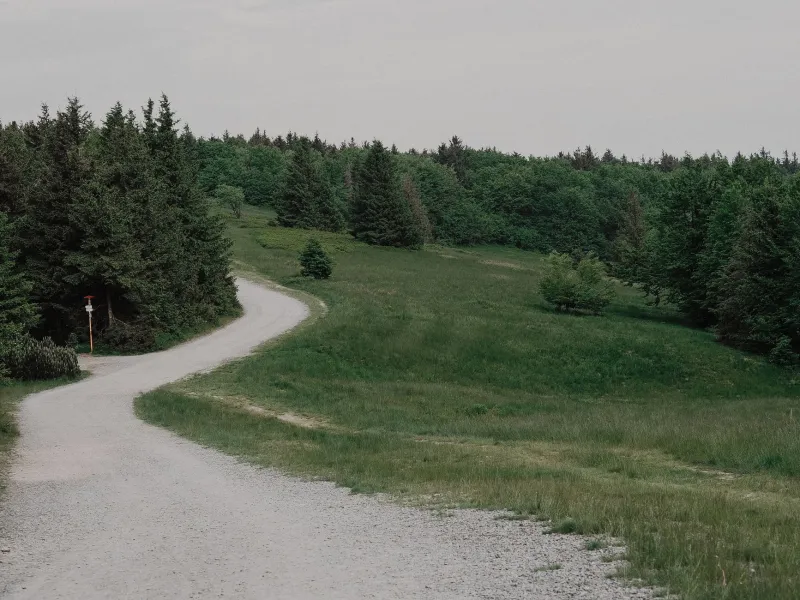
In the Appalachians, a pullout off a forest road in Pisgah or the White Mountains can be a mud puddle and a wall of rhododendron. The first mile is often an old roadbed, wide and graded. But the edge is where the gravel meets the moss, where a spring seeps out of the bank, where a fence line disappears into green. Slow down there and you might hear a winter wren before you hear your own boots.
In the Ozarks, the edge might be a gravel bar beside a low-water crossing. In a national forest in the West, it might be a cattle guard and a stand of sage. The specifics change. The instruction does not: arrive at the edge before you push through it.
Leave the Edge Alone
Noticing is not collecting. Take photos if you want. Take notes if that helps you see. But leave the scat, the bones, the feathers, and the flowers where they are. Do not turn over every log or chase a frog into the culvert. The point is attention, not extraction. Stay on the road or the established trail if the ground is fragile. In desert areas, the biological soil crust at the edge can take decades to recover from a single footprint.
The First Mile Is the Wildest
The first mile is not the obstacle between you and the wilderness. It is the wilderness showing its hand. It is the place where the wild is most tolerant of us, most adjacent, most willing to be seen. If you can learn to read that edge, you carry a different kind of attention into the backcountry. You stop waiting for the trip to start. You start where you are.
That is the whole practice. Fifteen minutes. No mileage. No summit. Just the gravel, the ditch, the fence line, and whatever is already there, watching you arrive.