Chasing the Clearing: Let the Forecast Pick Your Next Trip
Most trip plans are built backwards. We circle a Saturday six weeks out, stack the calendar with obligations, then spend the following ten days refreshing a forecast that has about as much predictive value as a coin toss. When the weekend finally arrives and the radar is a smear of green, we go anyway, or we bail and feel cheated.
There's a simpler trigger, and it isn't a date. It's the clearing.
The 72-Hour Rule
Anything past three days is a vibe, not a forecast. Ten-day outlooks are useful for daydreaming about a region; they are useless for deciding whether to drive four hours to a trailhead. So I don't make weather calls until the window is short enough to trust.
- T-minus 72 hours: Look at the pattern, not the number. Is a trough digging into the West? Is a ridge parked over the Southeast? Read the National Weather Service Area Forecast Discussion for the office covering your target — those paragraphs explain the reasoning behind the icons, including where the models disagree.
- T-minus 48 hours: Now the high-resolution models (HRRR, the short-range ensembles) are worth reading. This is when you can start believing timing: front arrives Thursday night, rain ends by mid-morning Friday, wind shifts northwest behind it.
- T-minus 24 hours: Commit or don't. Radar and satellite loops beat any text forecast for the last six hours. If two models are still arguing, assume the worse one and pick the lower-consequence plan.
That last point matters more than any app. Uncertainty doesn't mean cancel — it means choose the trip that survives being wrong.
What Each Kind of Weather Actually Hands You
Every weather event is also a gift, if you know which one you're being given.
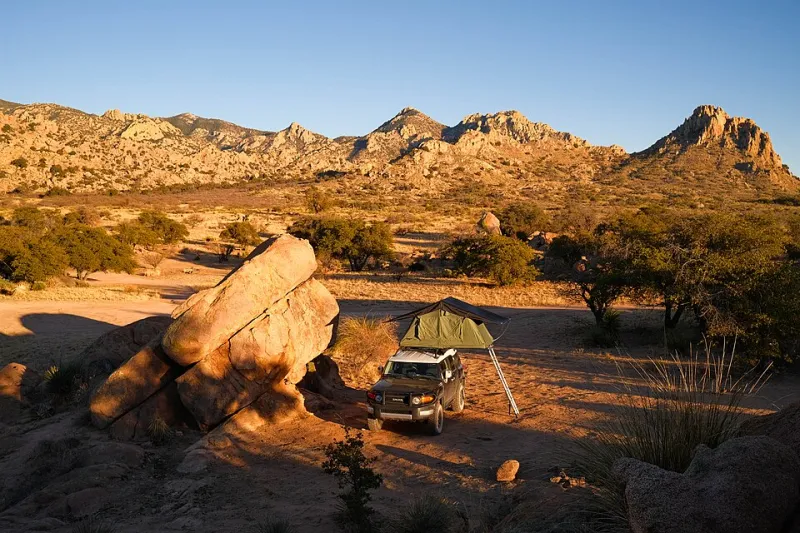
The desert cold front. In the Mojave, Anza-Borrego, Big Bend, or the canyon country outside Moab, a front in fall or spring scrubs the haze out and drops visibility to a hundred miles. Afternoon temperatures go from oppressive to perfect. The trade is wind — sometimes serious wind — so plan a low, sheltered camp and skip the ridge walk. Also: a front dumping rain upstream means narrow canyons are off the table for a day, even if your sky is blue.
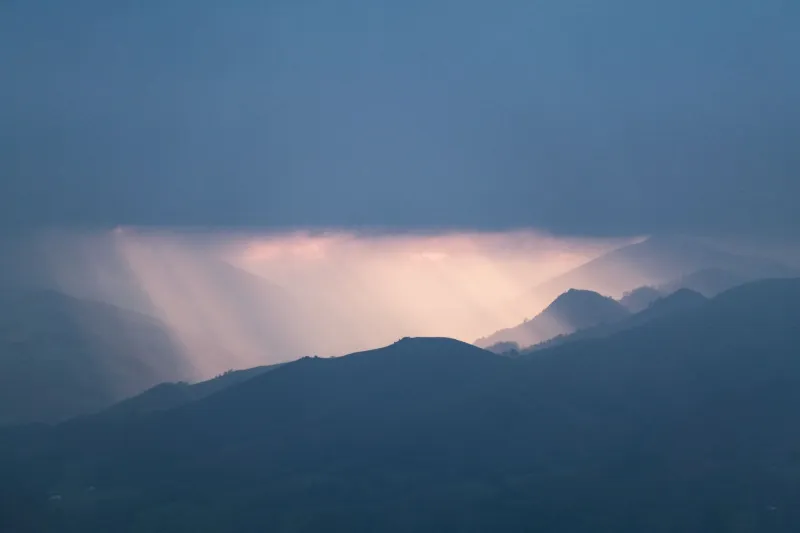
The Appalachian clearing. In Pisgah, Monongahela, Shenandoah, or the Smokies, the best ninety minutes of the week happen right as the rain quits. Fog lifts out of the coves, creeks run full, and low clouds snag on the ridges. Trails are empty because everyone else checked out at breakfast. Bring traction and expect mud; the light is the reward.
The high-country wind shift. In the Rockies, the Wasatch, or the Cascades, summer convection builds on a schedule. Storms fire early afternoon, the outflow wind hits before the rain, and then the air goes still and cold and clean. That's your window for exposed terrain — after the cell passes, not before it. Be off ridges and out of open basins by early afternoon and you'll rarely get caught.
The snow line dropping. In shoulder season, a storm doesn't have to cancel a trip; it can relocate it. If the high country picks up six inches in November, drop 2,000 feet and go walk a forest road instead.
A Three-Question Framework
I run this every time, usually in a parking lot with a phone in one hand.
- What's the hazard that would end this trip? Lightning, flash flooding, wind, or cold-and-wet. Name one. Generic "bad weather" is not an answer.
- Where can I go where that hazard is either absent or manageable? Not eliminated — managed. A forested ridge walk during a lightning forecast isn't managed. A valley loop with a car ten minutes away is.
- Do I have an alternate within ninety minutes of the trailhead? If the answer is no, the plan is too fragile.
Write your go/no-go thresholds down before you leave. Mine: I don't start a ridge hike if thunderstorms are forecast before 2 p.m., I don't enter a slot canyon within 24 hours of rain anywhere in its watershed, and I turn around if I'm wet and the temperature is under 50. Having the rule decided in advance means you're not negotiating with yourself when you're tired.
The Margins That Make Spontaneity Safe
Improvised doesn't mean unprepared. A few cheap habits buy a lot of room:
- Know your time to shelter. Count it in minutes from the crux of the route, not from the trailhead.
- Set a turnaround time, not just a turnaround point.
- Carry layers for the storm you're chasing the end of. Post-frontal air is cold, and wet plus 45 degrees is a genuine emergency.
- Leave a plan with someone who will actually notice. Cell service is a bonus, not a system.
Keep a Bag by the Door
A weather-window trip only works if a decision can become a departure in thirty minutes. I keep a duffel packed: headlamp, rain shell, warm layer, first aid, stove, and a printed stack of maps for five trailheads within three hours of home. When Thursday's forecast shows a Friday clearing, the only thing left to do is fill water bottles and go.
That's the other half of the payoff. Calendar trips herd everyone onto the same Saturday. Weather-window trips put you on a Tuesday morning two hours after the rain stopped, on a trail where the only tracks are elk and your own. The sky doesn't care about your schedule — but it will absolutely hand you a better one.